
What’s your initial reaction when you hear the word “accountability”?
It’s no secret that accountability is important in business. However, it often has negative connotations.
Research shows that people typically perceive accountability in one of two ways:
- Threatening
- Challenge-worthy
According to Harvard Business Review (HBR), when leaders take the first approach to accountability, their culture is often fear- and blame-based.
When accountability is perceived as an opportunity to grow, however, performance, learning, and well-being all improve.
In this article, learn strategies for elevating accountability to help your team achieve its goals.
What Is Accountability in the Workplace?
Accountability is often associated with punishment.
If an employee doesn’t do their job—or does it incorrectly—they’re held accountable through punitive measures.
However, accountability doesn’t have to be punitive.
Harvard Business School Professor and Teamraderie Advisor Amy Edmondson defines accountability as “psychological ownership.”

Accountability in the workplace is a commitment to achieve an organization’s goals and hold oneself to the company’s standards. While this often involves leaders holding team members accountable, it’s just as important—if not more so—for every employee to hold themselves accountable by taking ownership of their actions.
The problem with the punitive approach to accountability is that it ultimately discourages ownership and fosters a blame culture.
If you want to achieve your goals, accountability must be productive. A culture of fear, threats, blame, and punishment will ultimately distract you from your objectives and prevent employees from feeling safe to take ownership of their actions.
That said, here are some tips for elevating accountability at your workplace.
6 Ways to Improve Accountability at Work
1. Evaluate Accountability Systems for Bias
Research published in HBR revealed that when accountability systems are perceived as unfair and biased, people are almost 4x more likely to withhold or distort information.
This makes sense—if your team doesn’t trust that they’ll be treated fairly, they’re going to do everything they can to mitigate the risks to themselves.
According to HBR, organizations often implicitly prefer certain groups in their accountability systems. Even if your accountability system isn’t explicitly biased, it’s a good idea to ensure that there aren’t implicit issues hindering accountability at your organization.
HBR recommends asking questions such as the following:
- Who can access desirable opportunities?
- Are there any existing expectations about who is likely to succeed or fail?
- Is everyone able to contribute thoughts and ideas?
Consider implementing an anonymous survey that evaluates employee perceptions of accountability at your company or in your team. This can highlight potential issues that you might not have considered.
2. Encourage Individual Accountability
Research from Gallup shows that top-down approaches to accountability often fail to achieve their desired outcomes.
While top-down accountability is necessary, it’s also important to embed accountability within your workplace culture.
- Clarity: Clearly define employee expectations.
- Goal-setting: Help employees set and achieve measurable individual goals.
- Updates: Keep employees informed on information relevant to their goals
- Employee development: Provide learning and growth opportunities.
- Recognition: Celebrate and recognize employee accomplishments and successes.
Feedback and follow-through are vital to cultivate this culture.
It’s important to provide this feedback in a timely and compassionate manner. According to the Gallup article, neglected employees aren’t typically very motivated, whereas employees who feel cared for want to come through for their team.
3. Change the Goal of Accountability
Too often, the objective of accountability is to reprimand an employee for a mistake. Even attempts to get an employee back on track can come across as blaming.
It’s important to start by considering the objective of accountability in your organization.
Retired Lieutenant Colonel, fighter pilot, leadership expert, and Teamraderie experience host Tammy ‘G.’ Barlette explains that the goal should be learning, growth, and course correction, not blame.
Consider: When you have accountability conversations with employees, do you approach them from the perspective of “you did this thing wrong” or “let’s discuss how you can grow from this”?
It’s important to keep in mind that there might be things you could have done differently to increase your employee’s chances of success. Failure typically doesn’t happen in a vacuum.
Check in with yourself first by asking the following questions before approaching the other person:
- Was I clear about my expectations?
- Did I offer help or build a plan of action with my employee?
- Have I taken the time to review processes to see if they need improvement?
This might reveal areas in which you could have helped your team member succeed. When you hold yourself accountable as well as your team members, you build trust and help increase psychological safety.
4. Debrief Both Successes and Failures
According to Barlette, debriefs are an excellent opportunity to cultivate accountability and learn from both failures and victories.
Barlette, who hosts Teamraderie’s accountability-based “Debrief to Win” experience, explains that accountability should be applied consistently, regardless of the outcome. This means examining both successes and failures with the same level of intention.
This has three primary benefits:
Benefit 1: Reinforces a Positive View of Accountability
Intentionally celebrating wins helps shift the perception of accountability from reactive or punitive to constructive and forward-looking.
“Accountability shouldn’t be reserved for mistakes,” says Barlette. “When we debrief wins too, we reinforce learning, celebrate smart choices, and build a culture that values continuous improvement.”
Benefit 2: Sharpens Understanding of What Drives Success
Debriefing wins helps teams determine whether outcomes were driven by deliberate, effective actions or by chance.
According to Barlette, this distinction is vital. “Success isn’t always skill—it can be luck,” she says. “If we don’t analyze our wins, we risk repeating what worked once for the wrong reasons.”
If the success was process-driven, it can be repeated and improved. If it was luck-based, the team gains awareness and avoids false confidence.
Benefit 3: Creates More Opportunities for Recognition
Research shows that 79% of members of high-performing teams receive regular appreciation from managers, and 72% receive regular appreciation from colleagues.
By intentionally taking time to analyze successes, leaders naturally create more moments to recognize great work. This reinforces the right behaviors, boosts morale, and strengthens engagement across the organization.
In summary, as Barlette puts it, “Debrief the win. Learn from the loss. Repeat what works.”
5. Be Clear About Expectations
As was briefly mentioned above, clarity is vitally important.
Holding employees accountable isn’t likely to produce the outcomes you’re hoping for if you’re holding them accountable for something they didn’t know they were supposed to do.
Unclear instructions can lead to years of unknowingly incorrect practices by employees.
According to Barlette, leaders often believe expectations are clear simply because they’ve been stated, but true alignment only happens when those expectations are fully understood.
It’s important to recognize that setting clear, measurable expectations isn’t micromanagement. Many leaders skip this step out of concern they’ll seem overbearing, but defining the desired outcome and key boundaries doesn’t restrict autonomy—it enables it. When team members understand what success looks like and where the guardrails are, they gain the freedom and confidence to execute with clarity and ownership.
Practical Tips to Ensure Clarity
A powerful way to ensure clarity is to ask the team member to repeat back what they understood or explain how they intend to meet the expectation. This not only confirms shared understanding but also surfaces any gaps early, setting the stage for success.
“Clarity doesn’t come from what you say—it comes from what they understand,” says Barlette. “Great leaders close that gap before they ever open the door to accountability.”
HBR provides another key tip for clarity: keeping instructions adjective-free.
For example, consider the following sentence: “I need this done in a timely manner.”
The term “timely” will mean different things to different people. In this situation, clear expectations haven’t been set, and attempts to hold employees accountable might result in frustration.
Instead, provide a clear timeline for when you want a task to be completed. Clarity in advance will also give team members a chance to let you know whether it’s feasible to complete the task in the allotted time.
6. Prioritize Psychological Safety
Finally, and perhaps most importantly, cultivate psychological safety in your team.
It’s often incorrectly assumed that psychological safety and accountability conflict. This misunderstanding is due to a misconception of psychological safety as “comfort.”
Psychological safety is the ability to take interpersonal risks without being punished for them.
This pairs incredibly well with standards, ownership, and accountability, because when employees know what boundaries they aren’t allowed to cross, they feel safer engaging in risk-taking within those constraints.
In fact, Edmondson’s research demonstrates that an ideal workplace environment is one in which accountability and psychological safety are both elevated.
According to Edmondson, there are four zones in which teams operate at varying levels of accountability and psychological safety:
- Apathy zone (Low psychological safety and low accountability): Leads to disengagement and refusal to speak up, resulting in stagnation.
- Comfort zone (High psychological safety and low accountability): Employees are comfortable taking risks, but there’s not sufficient ownership over their outcomes.
- Anxiety zone (High accountability and low psychological safety): Results in fear that if someone speaks up or makes a mistake, they’ll be punished.
- Learning zone (High accountability and high psychological safety): Ownership is high, and employees feel safe taking risks, resulting in high levels of learning.
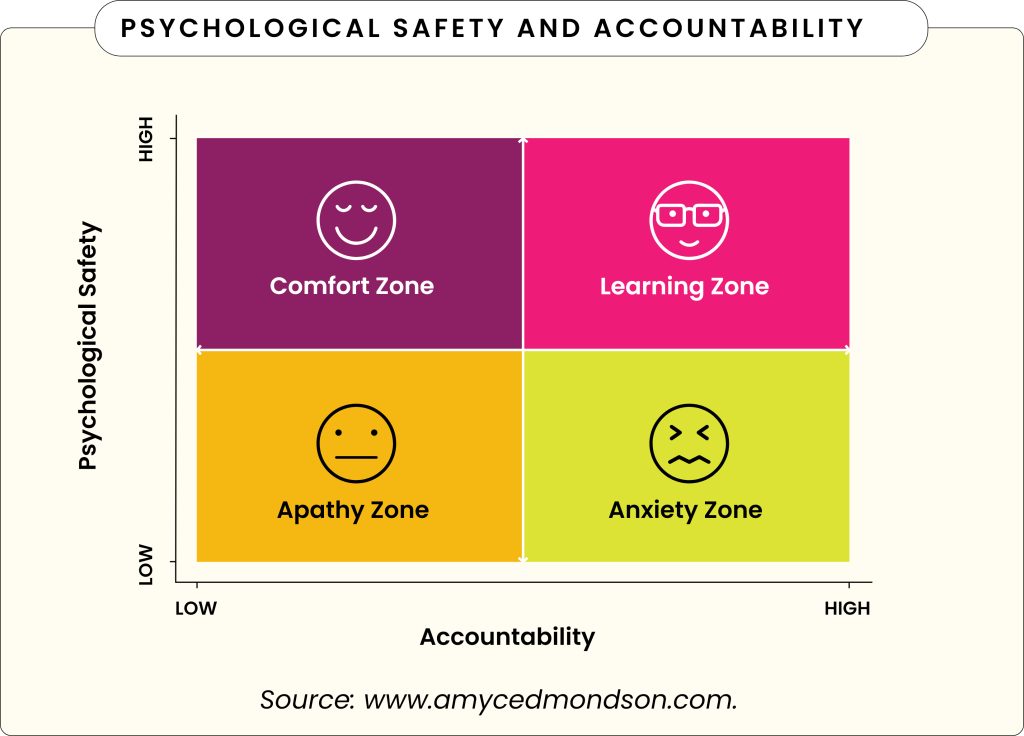
The learning zone in which psychological safety and accountability are both prioritized is the most effective environment for innovation and employee engagement.
Here are four ways Edmondson recommends enhancing psychological safety in the workplace:
- Solicit critical feedback: Ask for feedback, accept it with an open mind, and—if you agree—make changes. If you disagree, try to find an area of agreement to acknowledge while explaining why you have a different understanding.
- Give employees praise: Reward and recognize positive behavior. When you continuously acknowledge the good work employees are doing, you’re more likely to create a culture where employees take ownership of their individual failures.
- Provide constructive criticism: When an employee makes a mistake, let them know with the purpose of helping them grow from the error.
- Gauge the impact of your criticism: Consider the effect your criticism is having on your team. If there’s a better way for you to say something, learning to say it that way will benefit you both. Sometimes this requires more compassion, but it can also require more directness.
Notice the similarities between each of these points and the earlier suggestions on increasing accountability.
When you take a punitive approach to accountability, it might be difficult to cultivate psychological safety. However, when accountability is treated as ownership, psychological safety and accountability thrive together.
Does This Mean You Should Never Fire Anyone?
Unfortunately, sometimes firing people is inevitable.
You should always strive to help your team succeed, both for their sake and the company’s—after all, turnover is costly. However, in some situations—whether due to organizational changes, the employee’s actions, or some other reason—your team member needs to be let go.
Nonetheless, it’s important to do so with compassion.
According to HBR, the most important factor to consider when firing someone is how they’re treated during the process.
It’s important to ensure that your employee understands why they were fired, isn’t completely surprised by the news, and feels heard throughout the process.
Enhance Ownership With Teamraderie
If you’re hoping to enhance ownership-based accountability at your organization, it’s vital to equip your team with the communication and emotional intelligence skills required.
Teamraderie’s team experience, Debrief to Win, is an excellent place to start. This live, virtual workshop is led by a former U.S. Air Force Fighter Weapons School Instructor who will engage your team in an insightful discussion on enhancing accountability and conducting successful debriefs.
Click here to learn more about this experience and how it can benefit your team.